





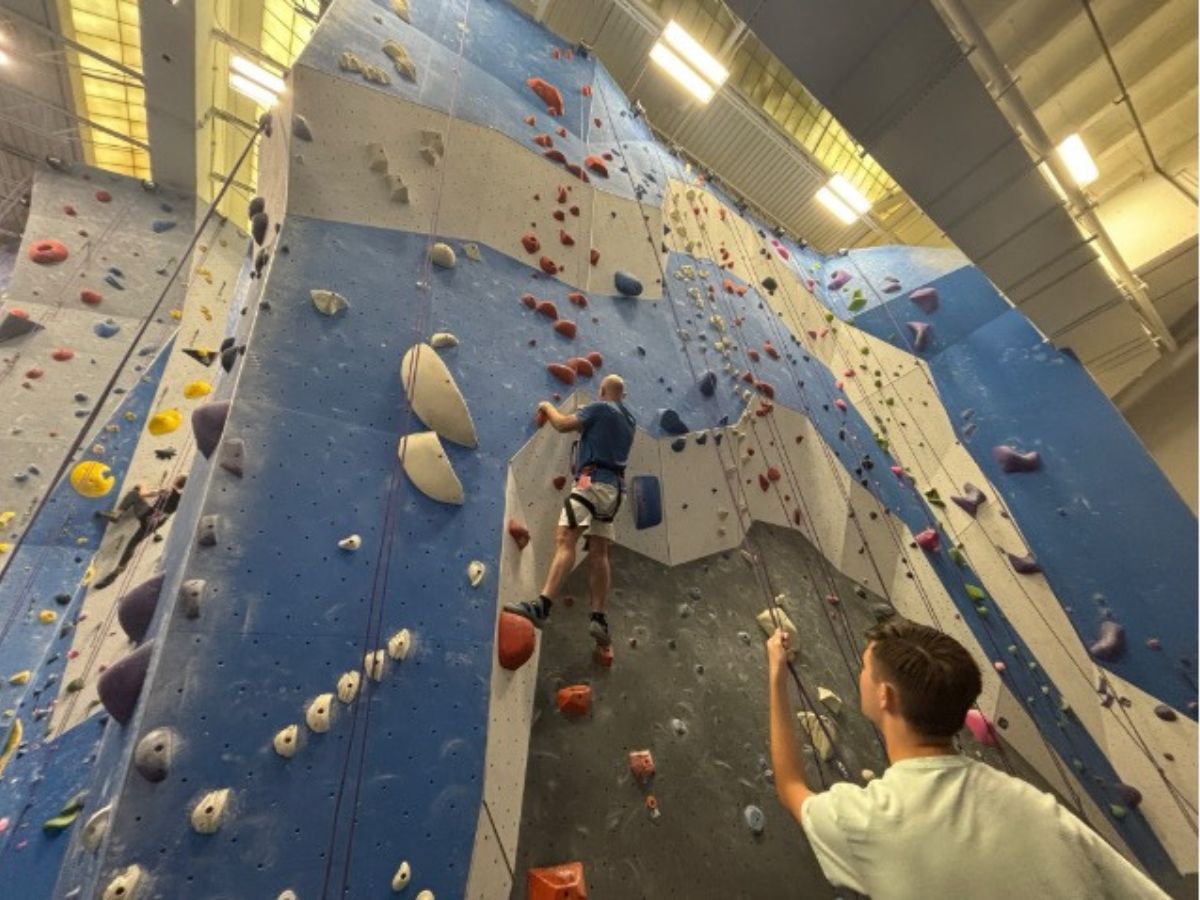
When you think of the traditional definition of therapy, what image comes to your mind? Many folks would answer with something akin to the classic scene from the 1989 classic Bill and Ted’s Excellent adventure, in which Keanu’s Reeves character Ted, laid back on a chair, is told by the Sigmund Freud (time travel shenanigans if you haven’t seen the movie) that his father’s fear of failure has transferred onto him. Reeves sits straight up and proclaims “Woahhhhh” awestruck by the breakthrough Freud has provided him. Now, maybe this cliche isn’t what you picture when you think of traditional therapy, but I am willing to bet the image did not include scaling walls by method of plastic rocks. Indeed climbing therapy may be a little out of the box, but when you examine the parallels to many of life’s challenges, the awareness it brings to your body, and the confidence it can instill, it begins to make a lot more sense.
Terminology
Before we get into it, there are a couple key words/vocabulary that are useful to know when talking about climbing:
- Bouldering: this is one of the two main types of climbing and involves shorter walls with no ropes. The height is safe enough to fall from and climbers use their bodies to climb from the start point, to either the finish hold or the top of the wall depending on what the particular climb is asking you to do.
- Top Rope: this is the second of the two main types of climbing and involves two people, one on the ground who makes sure the rope is tight and the other who is the one climbing while being safely held up by the rope. The rope is fed through a belay device, thus the person holding the rope being referred to as the belayer.
- Belay Device: mentioned above, this is the device that the rope is fed through. The belayer pulls the rope taught as the climber goes up so that if they slip, or want to take a break, they don’t fall when letting go of the wall. Of course, if the person belaying makes a mistake, the rope will catch the climber even without intervention from the belayer as it is an incredibly safe system. It is equally the responsibility of the climber to communicate their needs to the belayer as everyone likes the rope to be a different level of taut.
The Impetus
I hated rock climbing. When I first started I hated every second of it, the soreness in your hands, the sweat and fear that came with being off the ground , the amount I struggled with it, just about everything. After about three or four trips to the climbing gym with friends I was just about done. Then my friend asked me to go one more time and said if I hated it, I never had to go again. Seemed like a reasonable deal so I went. On that day, when once again I thought I couldn’t finish a wall my friend encouraged me to keep going and I was able to finish my first bouldering problem. No ropes, just me and my body from the ground to the last hold. That’s when it clicked. I was hooked. The feeling of adrenaline and the endorphins that flooded my body after completing what I had initially thought would be impossible for me felt incredible. Despite my fear of heights, my perceived weakness, I wanted to climb more walls. I wanted to keep going. This experience was life changing for me and after seeing climbing transform the lives of many others around me, I wanted to bring it to others. Being a therapist, the clinical applications stood out to me right away and after a bit of research, I was not the only one:
“The studies investigating TC[therapeutic climbing] outline its positive effects in various patient groups. TC is a safe and effective treatment for improving physical/mental/social well-being. This review is based on the best available evidence; however, significant gaps remain in providing sufficiently strong evidence.” (Gassner et al, 2023)
While therapeutic climbing was still a relatively new intervention, people all around the world were beginning to apply it with signs continually pointing towards its positive effects. Looking back at my own experience it’s easy to see why: rock climbing builds real skills that can be applied to both the gym, and life.
Encouragement- When you’re struggling on the wall, whether halfway up or still on the ground, it is often fellow climbers who provide that voice of encouragement that gives you the final push to move forward, or up in this case.
“The word can’t is banned, at least for right now!”
“ It was fun talking with others around me and helping each other give ideas on how to climb higher on the next attempt”
Confidence- One of the most satisfying aspects of running these groups is watching the participants get more and more sure of themselves as they accomplish things they did not think they were capable of doing. Going from the fear and trepidation of even getting on the wall, to eventually scaling 40 foot tall walls is inspirational.
“Problems stop being problems if you try hard enough”
“I enjoyed pushing myself to what I previously thought I was unable to do. I have a fear of heights, and climbing is surprisingly easy once you get the hang of it.”
Resilience- Climbing is a sport of failing. You are going to fall, fail, fear, and become frustrated many times before you accomplish your goal or finish that wall you’ve been working on for weeks. Those failures, and the determination to keep getting up and trying again is what ultimately leads to finishing that pesky climb you’ve been so close to getting for so long. But it also leads to facing those frustrations outside the gym
“50% of it is mindset and 50% of it is skills. If I say I can do it I can do it”
“I’ll be able to do it some day”
Trust- Trust comes in two major forms in climbing: trusting ourselves and trusting our belay partner. When climbing, many moves require you to trust that you will be able to hold on and grab the next hold. Put another way, in order to finish many climbs, you have to take a leap of faith and put trust in yourself and your body. Now, sometimes this leap of faith is very literal but the point still stands. When top roping, you have to trust that your partner will make sure to pull your rope tight as you climb up and that they will be attentive to the communication of your needs. Whether you ask to take a break and hang in the air to recuperate your strength, or you ask them to let you down. In our groups, the person who belays you most often starts out as a stranger, and you are asked to put your trust in them. How often have you been asked to put your trust in someone despite not knowing them at all. Whether at work with new coworkers or in our personal lives when being introduced to friends of a friend, we are asked to take that leap of faith. That leap can become quite a bit easier if you are used to taking a leap on a weekly basis.
“I was surprised at how good people were able to work together”
“People are good at communicating”
What Therapeutic Climbing Can do for You
Awareness and the Physicality of Climbing, and How to Use it
The most common thing I hear when people doubt their ability to try climbing for the first time is “I can’t even do a pull up”. This makes total sense as you are indeed pulling yourself up the wall. But doing a pull up is not a prerequisite for climbing. While it is true that you use a great deal of upper body strength on the wall, you use almost an equal amount of leg power to propel yourself upward. Climbing will use muscles you weren’t aware existed and the next thing you know, you’re using your knees! This is a real climbing technique known as a knee bar and it can sometimes scrape your leg up if you don’t wear long pants. You can also scrape your hand, your arm, your ankle and other parts of your body if they come in contact with the wall. No matter what though, you will be aware of where that scrape is. This is the body awareness that comes with climbing. As you go up the wall, and subsequently farther off the ground, you become increasingly aware of the placement of your feet. Where your arms are in relation to the next hold, how your balance is and how you may need to shift your weight to feel more secure. This sense of awareness comes with time, but it starts from the first time you’re on the wall. Sometimes this awareness can drown out the other senses until it’s just you, your fear, and the wall. But it is herein that lies the clinical applications of that awareness.
Life is overwhelming and sometimes we are overcome by anxiety and uncomfortable feelings that make it difficult to function. As humans, many of us are born with a fear of heights due to it being, well, dangerous to both us and our ancestors. For many, we come face to face with that fear when we are several stories up in the air held up by a rope tied to a harness. Indeed when the awareness of your body begins to drown out your other senses, and you viscerally feel the harness digging into your thighs. The soreness of your forearms, and the breath heaving in your chest you come face to face with a mirror for that aforementioned discomfort and anxiety. When you are able to climb through that feeling, and move up in spite of it, it becomes a memorable experience. One that you can draw on in those moments outside of the gym. When you feel anxious and like you can’t get through something, that sensation of the harness, the heavy breath and the soreness can come back as a reminder that you have been here before and that you, through your own power, have climbed through it. This is often the core idea behind taking a client to the gym for a one on one session. Using real life, physical experiences to bolster coping skills.
The Power of Belief
One of my favorite quotes from a participant has already been mentioned, but it’s so good I’m gonna use it again and no one can stop me: “50% of it is mindset and 50% of it is skills. If I say I can do it I can do it”. This quote is incredibly salient not just to climbing, but to life as well . While there is the physical aspect of it and there will be climbs you cannot do until you build grip strength, there are also those that you physically can do but don’t believe you can do. Until you believe and trust yourself to do them, they will remain impossible. Sound familiar? In this way climbing once again acts as a mirror for the oh so common self-fulfilling prophecies in our lives. That job interview you believe you will fail so it doesn’t go well. The baseball game where you believe the pitcher is too good so you struggle to hit. By choosing to believe in yourself, you are empowered to at least do marginally better. It isn’t foolproof, but the power of belief is not to be trifled with. Through climbing, it can be bolstered.
Gaining a Clear Mind Through Plastic Rocks
Over the past couple of years, Netflix has created more and more media catering to its platform being a “second screen”. That is to say, those watching while doing something else usually scrolling on their phone. Now, while I am most certainly not advocating for doom scrolling, I am saying that this is a good metaphor for multi-tasking. Therapy is hard. You have an hour tops to talk about things that have been plagueing you for, sometimes, years at a time. It can be difficult to hone in on what aspect to talk about, or narrow down the part that sticks out to you the most. While talk therapy is incredible and helps millions of people, sometimes you don’t want to sit on the couch. Sometimes you want to walk and talk. Sometimes you want to shoot hoops. Sometimes you want to climb. One of our jobs as therapists is to meet clients where they are at. In doing so, that may mean providing a client with an alternative setting for them to move around and do an activity while they talk. Just like the trail behind our practice has been the site of many breakthroughs, so too can the climbing gym. Being on the wall and being zoned in and focused on the problem you’re climbing can provide you with the mental clarity to hone in on what about that particular class stressed you out.
Partnership
The main content and structure of rock climbing therapy groups changes depending on the age of the participants. Since you can only belay other people if you are 13 years old or older, our groups made up of that age group focus primarily on top rope climbing. The first session teaches participants how to belay and then each session, they are paired up with a different partner. Together each pair explores different walls and helps each other build confidence, with the belayer providing guidance and encouragement from the ground, they can sometimes pierce through the self doubt or the fear held by the climber and help them take just one more step up. A belay partnership cannot be done without trust, self-advocacy, and communication. Once again, climbing becomes a mirror for our relationships. All three of these are key elements to a successful relationship of any kind.
How Does one “Go Climbing?”
At Cabush Paul & Associates, we have several different ways a client can engage in therapeutic climbing. There is an upcoming middle school group that will start in September 2026, and several other groups for highschoolers and young adults currently in the works. Both myself and some of our other clinicians take their clients climbing when they feel like it is salient to the work they are doing, or if that client needs a secondary activity to help them hone in. We invite anyone who feels like they would be a good fit for any of these options to reach out. We would love to have you!
If you would like to try climbing on your own and explore what it can do for you, I would encourage you to check out one of the numerous climbing gyms in the Northern Virginia area. The majority of them offer free first time visits which includes all the gear you may need. If you are a parent interested in bolstering the trust between you and your child, sign up for a belaying class and explore how you feel afterwards. If you want to explore climbing for yourself, try climbing a problem you cannot picture yourself completing and see how far you can get. Explore that feeling.
– Written by Jacob Stein
Interested in Rock Climbing Therapy?
Learn more about our Rock Climbing Therapy program and how it helps teens and young adults build confidence, resilience, and connection by clicking here.